
COMMUNIQUÉ OF THE 19TH ANNUAL SCIENTIFIC CONFERENCE AND ALL FELLOWS’ CONGRESS ORGANIZED BY THE POSTGRADUATE MEDICAL COLLEGE FELLOWS ASSOCIATION IN COLLABORATION WITH THE NATIONAL POSTGRADUATE MEDICAL COLLEGE OF NIGERIA
(ASCAF CALIPHATE 2025) HELD FROM AUGUST 3RD TO 8TH, 2025, AT THE INTERNATIONAL CONFERENCE CENTRE, KASARAWA, AIRPORT
ROAD, SOKOTO STATE, NIGERIA.
BACKGROUND
The Postgraduate Medical College Fellows Association (PMCFA) is the registered association of all medical and dental specialists trained by the National Postgraduate Medical
College of Nigeria (NPMCN), home and abroad. The National Postgraduate Medical College of Nigeria, established by decree No. 67 of September 24th, 1979, now CAPNo. 59 Laws
of the Federation 2004, is the apex institution for postgraduate medical education in Nigeria. Since its inception, the College has trained over 9,000 Medical and Dental Specialists,
saving the nation billions of dollars that would have otherwise been spent on overseas training ill-suited to Nigeria’s healthcare realities.
Beyond its flagship Fellowship programme, the College introduced the Doctor of Medicine (MD) degree to strengthen research capabilities and foster innovation among its graduates. It
also runs various diploma programmes through the Faculties. Today, NPMCN alumni occupy pivotal roles across Nigeria and globally, serving as Lecturers, academicians, healthcare
administrators, and research scientists in both public and private sectors.
The 19th Annual Scientific Conference and All Fellows’ Congress (ASCAF Caliphate 2025) took place at the International Conference Centre, Sokoto, from August 3rd to 8th, 2025.
CONFERENCE THEME & SUB-THEMES
Theme: Leveraging Technology, Innovation, and Diversification to Revolutionize Postgraduate Medical Education in Nigeria. Sub-Themes: Beyond the White Coat: Smoothing the
Transition from Clinical Practice to Retirement; Expanding the Horizon: Integrating Private and Corporate Health Sectors into Postgraduate Medical Education, and From Policy to
Practice: Implementing Nigeria’s National Health Workforce Migration Policy.
PROCEEDINGS & HIGHLIGHTS
The conference commenced with a courtesy visit by the College’s leadership, led by the President, Dr. Peter Ndidi Ebeigbe, MD, FMCOG, PNMC, to key dignitaries, including: His
Eminence, Sultan of Sokoto, Alhaji Muhammad Sa’ad Abubakar III, CFR, mni, FNMC, Vice Chancellor, Usmanu Danfodiyo University, Prof. Bashir Garba, PhD, MFR, Honourable
Commissioner for Health, Sokoto State, Dr. Faruk Umar Wurno, PhD and Chief Medical Director, Usmanu Danfodiyo University Teaching Hospital, Prof. Anas Ahmad Sabir, FMCS.
The Opening Ceremony on August 5th, 2025, was chaired by Professor. B.B. Shehu (FMCS, FWACS, FRCS, FACS), Vice Chancellor, Federal University of Health & Biomedical
Sciences, Funtua, Katsina State. Distinguished attendees included the Deputy Governor of Sokoto State, Engr. Idris Muhammad Gobir (representing His Excellency, Alhaji Dr. Ahmed
Aliyu Sokoto, the Executive Governor). The Kebbi State Commissioner for Health, Alhaji. Yunusa Isma’il (representing His Excellency, Dr. Nasir Idris, PhD, the Executive Governor of
Kebbi State). The CMD, UDUTH Sokoto, Professor. Anas A. Sabir (representing the Coordinating Minister of Health, Prof. Muhammad Ali Pate, CON) . The Vice Chancellor, Usmanu
Danfodiyo University, Professor. Bashir Garba (representing the Minister of Education, Dr. Morufu Tunji Alausa). His Eminence, Sultan Muhammad Sa’ad Abubakar III, CFR, mni,
and other royal dignitaries. The opening ceremony featured the Professor Theophilus Oladipo Ogunlesi Annual Lecture, delivered by Prof. Basden J.C. Onwubere (BM, BCh, FMCP,
FWACP, FACP, FESC, ISHF, FAcadMedS, FNCS, FCRPEdin). Titled Combating the Silent Killer in a Declining Economy: The Role of the College,” the lecture addressed strategies to
mitigate hypertension—a disease projected to affect 1.5 billion people globally by 2025, with 75% of cases in developing nations.
The Wednesday Presidential Session witnessed the recognition of three distinguished senior fellows of the college who had contributed immensely to postgraduate medical education in
Nigeria and the nation. The three of them delivered very insightful lectures, including Emeritus Professor. S. C. Ohaegbulam, NNOM, a former Professor of Neurosurgery at the
University of Nigeria, Nsukka; Professor Angela Anene Okolo, a retired professor of Paediatrics at the University of Benin, Benin City and Emeritus Professor Idris Mohammed, a
former professor of Medicine at the University of Maiduguri, Nigeria.
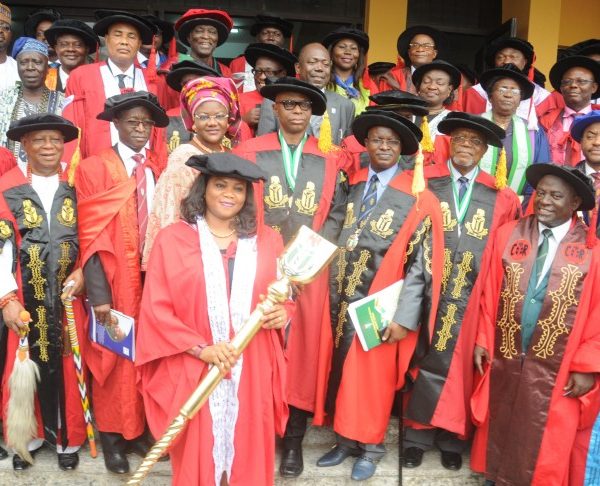
The key activities on Thursday included the award of the Honoris Causa Fellowships to twelve distinguished individuals, eleven Nigerians and an American. There were seven (7)
plenary sessions on the conference theme and sub-themes. Two hundred and four Peer-Reviewed Papers & 51 Poster Presentations were published in the Conference Proceedings. The
pre-conference workshops on Manuscript Writing and Faculty-Specific Training Sessions held on Monday August 4th, 2025.
OBSERVATIONS
1. The Corporate private health sector has resources that can potentially bridge the gap in postgraduate medical education in Nigeria.
2. Globally, institutions are integrating AI into curricula to improve competency-based education and lifelong learning.
3. Digital health is transforming healthcare for both clinicians, patients and policymakers.
4. A20-year projection predicted five scenarios as to what academic medicine might look like in 2025 as Academic medicine Inc. flourishing in private sector; Reformation where
all clinicians teach, learn, research and improve; Be in the public eye with success coming from delighting the patients, the public and media; a scenario of Global academic
partnership with global networks devoted to redressing health inequities and the 10:90 gap; and a scenario where academic medicine has achieved stakeholders’ Full
engagement with strong connections among patients, policy makers, practitioners, and the public.
5. Aclinician distracted by personal financial stress partly from inadequate compensation is dissatisfied and half-as-present at the bedside with a strong drive to migrate.
6. Healthcare entrepreneurship is an overlooked or inadequately addressed component within medical education
7. There is significant migration of doctors young and old, out of the country that is negatively impacting on medical education, research and service delivery.
8. There is also internal migration to urban areas where more attractive conditions abound with higher safety.
9. The National Health Workforce Migration Policy (2024) seeks to mitigate brain drain and attract diaspora returnees but there is no visible implementation efforts and no
commensurate significant strive to address the drivers of health workforce migration such as low salaries and poor working conditions.
RECOMMENDATIONS
Following fruitful deliberations at the plenary sessions, scientific presentations and the All Fellows Congress, the following recommendations were made:
1. There is a need to pool resources and integrate the private sector in postgraduate medical education in Nigeria.
2. There is a need to develop a phased roadmap clearly outlining the integration of AI into medical education curricula and institutional practices; Strengthen institutional capacity
through targeted training programs, resource allocation and stakeholder workshops; Establish national AI oversight committees responsible for policy development,
monitoring, compliance and addressing ethical issues; and Foster interdisciplinary collaborations to leverage diverse expertise, accelerate innovation, and facilitate effective
implementation.
3. To realize the full benefits of digital Health, there is a need to overcome the challenges related to infrastructure, data management, and user adoption
4. Nigeria should strive to ensure that academic medicine has a prime place to advance collaboration, research, development and innovation.
5. Governments need to review the welfare and remunerations of practitioners while the practitioners should develop the skills of financial planning and debt management,
financial immunity through savings and insurance, and a diverse portfolio of investments.
6. Healthcare entrepreneurship should be integrated into medical education at all levels.
7. There is a need to address the drivers of health workforce migration such as mainstreaming an attractive welfare and remuneration package supported with advanced facilities
and technology to attract and retain workforce in the country and in rural areas where skilled personnel make the most impact on citizens’ morbidity and mortality. This will
hopefully motivate those in the diaspora to return and make an impact on the system at home.
8. There is a need for governments to urgently act on the pervasive corruption across the systems and address the disparities in pay between governments at different levels.
APPRECIATION
The PMCFA and NPMCN extend profound gratitude to: His Excellency. President Bola Ahmed Tinubu, GCFR; The Chairman of the opening Ceremony occasion, Prof B.B. Shehu
FMCS, FWACS, FRCS, FACS, Vice Chancellor, Federal University of Health & Biomedical Sciences, Funtua Katsina State; His Excellency, the Executive Governor of Sokoto,
represented by the Deputy Governor of Sokoto State, Alhaji Idris Muhammad Gobir, Members of the Sokoto State Executive Council, Special Advisers to the Governor, His Excellency,
the Executive Governor of Kebbi State, represented by the Honourable Commissioner of Health Kebbi State Yunusa Ismail, The Coordinating Minister of Health & Social Welfare of
the Federal Republic of Nigeria, Prof Muhammad Ali Pate Minister of Education Dr Morufu Tunji Alausa represented by the Vice Chancellor, UDUS Prof Bashir Garba, The Minister
of State for Health, Dr. Iziaq Adekunle Salako represented by Dr Abubakar Baguda, CMD Federal Neuropsychiatric Hospital Kware, The Royal Father of the day, His Eminence,
Alhaji Muhammad Sa’ad Abubakar III CFR Honorary Fellow of the National Postgraduate Medical College, Emir of Azara (Nasarawa State) HRH Dr Muhammad Kabir Ibrahim
FWACS, President and Past Presidents of the National Postgraduate Medical College, our distinguished Fellows, Chairman and Members of Local Organising Committee, security
agents, partners and supporters, gentlemen and ladies of the press, distinguished guests and participants, All dignitaries, royal fathers, and government representatives, Security
agencies, partners, and the media, Fellows, participants, and the Local Organising Committee.
Dr. Simeon Isezuo, MHPE, MD, FMCP
Chairman, LOC ASCAF 2025
Dr. Temitope A. Esan, MD, FMCDS
College Registrar, NPMCN
Dr. Peter N. Ebeigbe, MD, FMCOG, PNMC
College President, NPMCN